
Notes on innovation
Afraid of AI taking your job? read this

This is my 3rd attempt to write a counterargument to “AI will replace us all. (past attempts: “When a Ceiling Becomes a Floor” and “Notes on Impressionism”)
Supply and demand
People are always looking for ways to be useful. We solve problems, help each other, build, and create things.
We spend time, money, attention, and other resources on things that improve our lives or solve our problems. So value is whatever other people are willing to reward (money, fame, recognition, etc.).
Market disruptors
When a new technology arrives, it changes the supply & demand dynamics that determine the value hierarchy.
A profession that used to be really valuable is not that valuable now. Being a software engineer used to create 100 units of value to society. Then Claude comes along and takes over 80 of those units, leaving the engineers only reviewing Claude’s code.
But that conclusion assumes value is fixed. It assumes there is some finite amount of usefulness available in the world and that every technological advance permanently reduces humanity’s role.
That’s the misconception.
When a ceiling becomes a floor
Those 80 units don’t disappear. They become commoditized.
What once required skill, training, and human effort becomes cheap, abundant, and automatic. Its value collapses toward the cost of the underlying technology (energy, compute, tokens, etc).
And that’s where the old ceiling becomes the new floor.
Humans don’t stop creating value. They shift focus.
We shift our attention to the remaining 20 units - the parts that are still difficult, scarce, and valuable. We dive into what’s left and find a new edge.
Over time, those 20 units stop feeling like “what’s left.” They become the new center of the profession.
Good software engineers are now agent orchestrators and swarm architects.
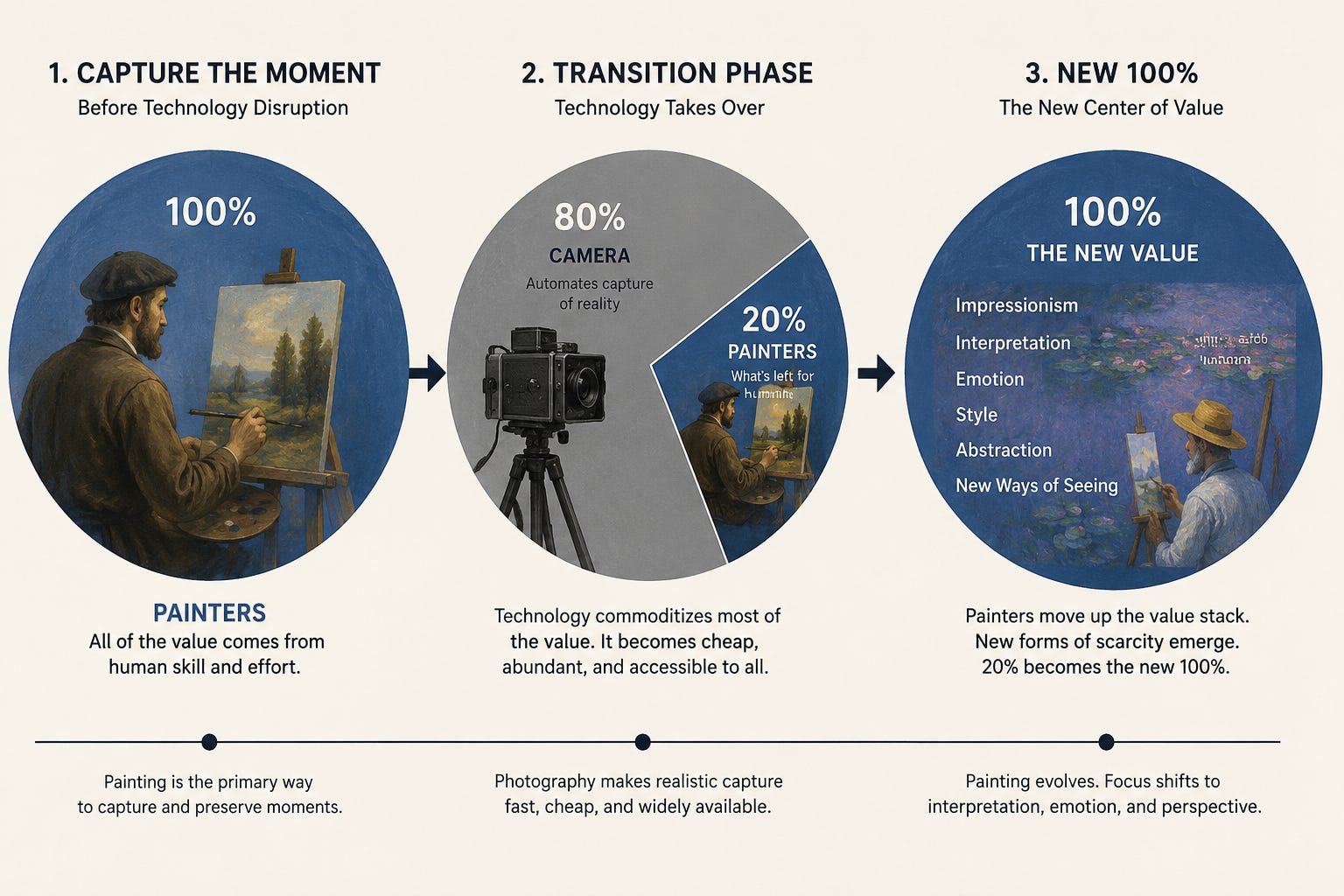
The remaining 20 becomes the new 100.
This is what happened when photography arrived. Cameras took over much of the value painters once provided as accurate recorders of reality. Instead, realistic representation became abundant. So painters moved elsewhere.
They explored interpretation, emotion, perspective, style, abstraction, and entirely new ways of seeing the world. The profession didn’t disappear. The value hierarchy shifted.
AI
The same dynamic plays out with AI.
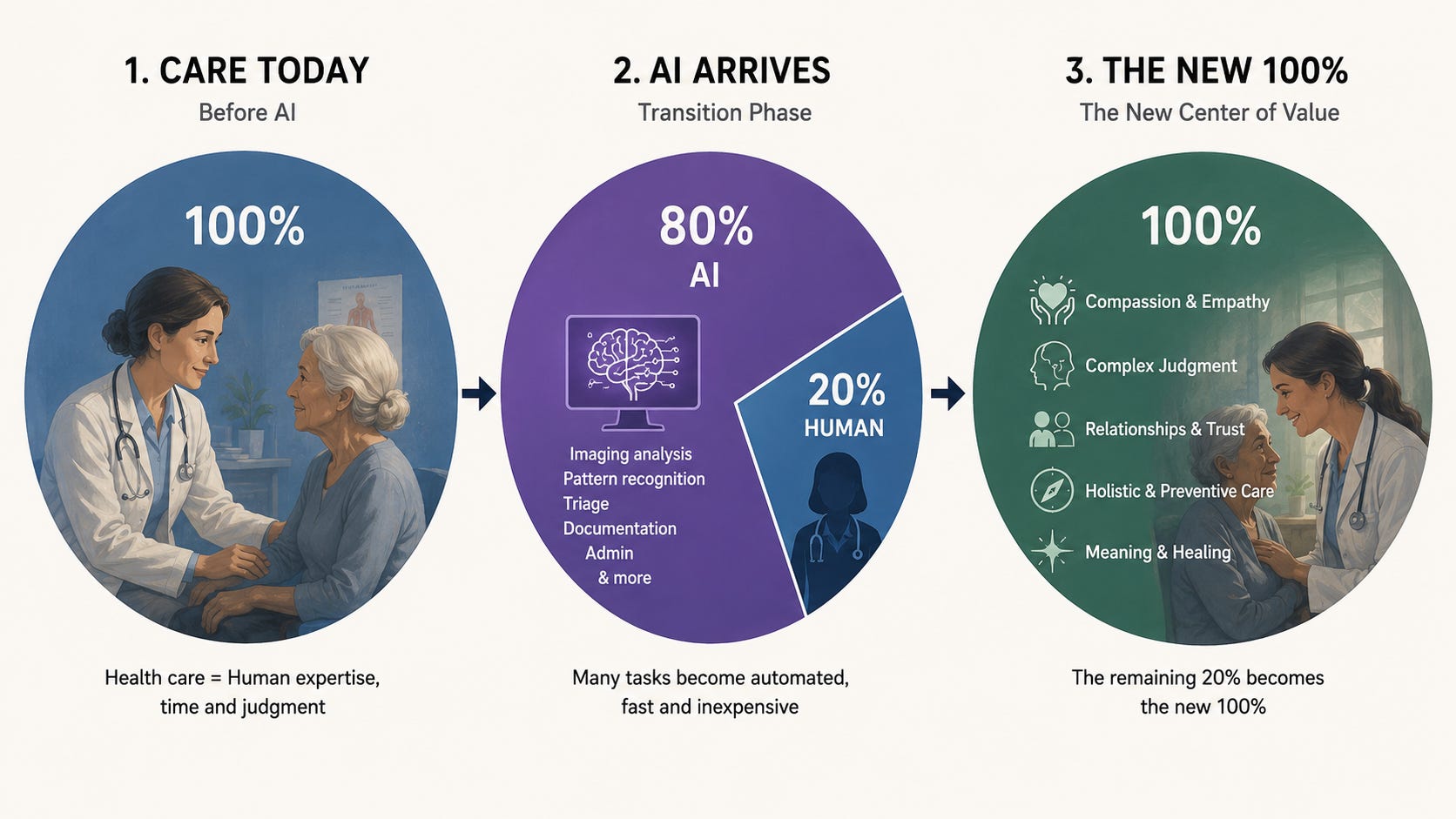
Legal research, diagnosis, coding, writing, design, analysis, and countless other tasks may become increasingly commoditized. Their value may collapse toward the cost of computation.
But that does not imply the end of human value creation.
It implies a migration.
As some forms of value become abundant, humans will move toward whatever remains scarce: judgment, taste, trust, creativity, strategy, relationship-building, leadership, meaning, and perhaps entirely new forms of contribution that are difficult to imagine today.
The history of civilization is not a story of humans running out of useful things to do. It’s a story of humans continually moving up the value stack.
Great Analogy on painting. Love's this.
Loved this one, and fully agree!