
Two completely different angles of the same fucking thing.
Why does the sun go on shining?

Prologue: Messy thinking
Reference to the title is here.
In this very messy piece, I’m trying, and mostly failing, to communicate what communication feels like to me.
I start by exploring the limitations of language, and then move into what I call information–resolution elasticity - the idea that the more detail you try to transmit, the harder it becomes, and vice versa.
From there, I wander into quantum mechanics, playing with the notion that ideas behave like particles when measured and like waves when left alone.
As people, I think people do this, too. We experience a kind of decoherence effect.
The closer we are to others/society, or the more exposed we become to other ideas, the more we collapse into a single, binary world.
Note on loneliness by Andrew Tarkovsky.
That’s why isolation, the refusal to be “measured,” to collapse into one fixed definition, can be so fascinating. It keeps you suspended in that probabilistic, superposed state, where multiple versions of meaning can coexist.
Ready? let’s start.
Chapter 1: The color red
What’s this thing we call “Red”? In a way, there is no such thing.
“Red” is a simplified representation of a range of visible wavelengths.
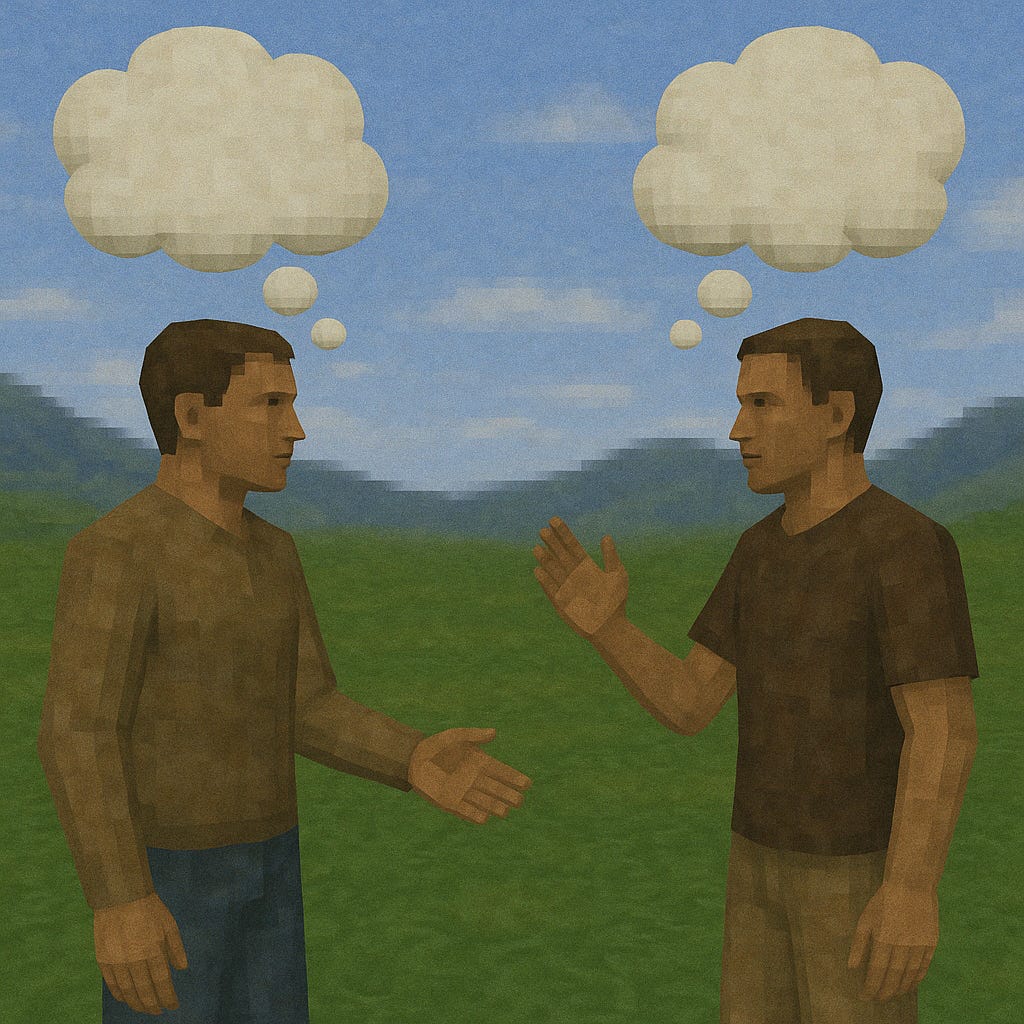
When I say “I’m sad”, this is a reduction of a complex range of emotions into a single representation, making it communicable.
Raw data floats in space, and different organisms come up with various ways to communicate their point of view (perspectives, space-time angle) of this raw data with each other (“red”, “sad”, etc).
Why are we doing this? Why do we share information with each other? Maybe, to piece together a bigger picture from our individual perspectives.
Each of us sees a fragment of the puzzle, one point of view in space-time, and together, we try to understand the complete, multi-dimensional image of the world.
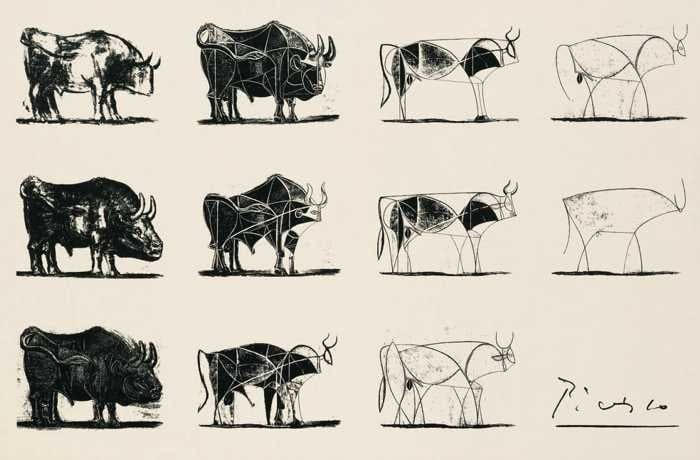
Draw me a sheep
Why can’t I describe the EXACT color I’m seeing? And instead I just come up with: “It’s red”? Why can’t I fully express my emotions? And I just say “I’m sad”?
Because describing the raw data of the experience would take an enormous, possibly infinite amount of time.
It’s a tradeoff between how much energy I put in when communicating and how much information I transmit.

Communicating requires us to simplify: we turn the raw, multidimensional data of our experiences into symbols, words, or gestures that can be easily shared and understood.
Whenever we transfer information from one person to another - feelings, thoughts - some of it is inevitably lost (laws of nature), much like how moving objects lose energy to friction or electricity loses energy during transmission.
When I say “I’m happy,” I lose the subtleties and the intricate shades of my experience for the sake of being understood, hoping the listener fills in the gaps with their own interpretation and memory.
We compress infinite complexity into finite language. We create patterns in chaos (reduce entropy).
Chapter 2: Communication circles
Circles
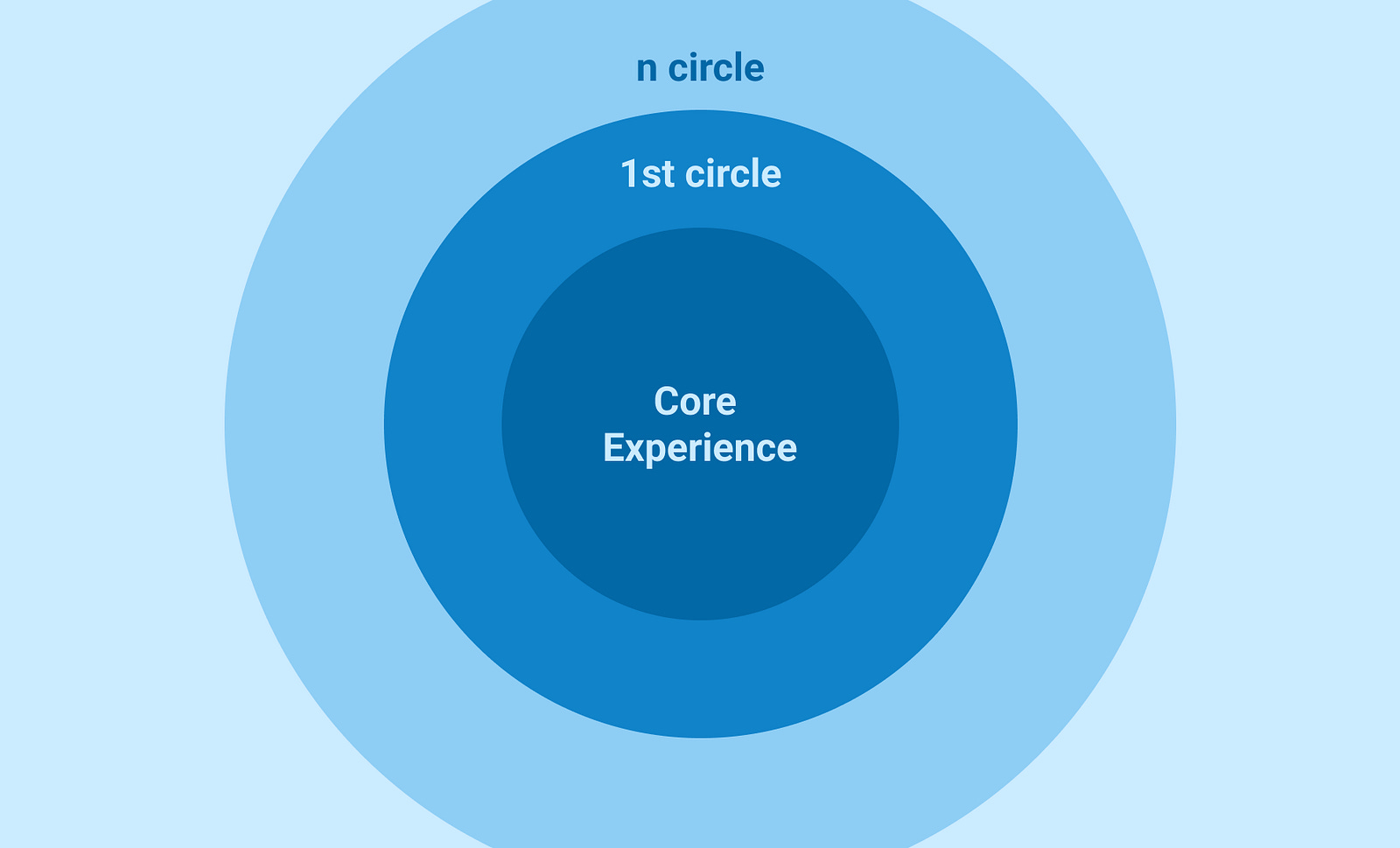
Let’s think of the “communication” as a series of circles, one inside the other.
The center, the nucleus, represents the root, core experience (raw information). Within the nucleus, the information is rich, wavy, probabilistic, and multidimensional.
As you move outward from the center, the message undergoes a decoherence effect (we will return to that later). It becomes distilled and simplified, stripping dimensions and layers of information.
When a message travels from the core outward, it is stretched thin to fill the larger circles, making it less accurate (less representative of the core experience) but easier to transmit.
Inner circle: “There’s a heaviness in my chest and pressure behind my eyes. It’s harder to care about things that usually matter, and even small tasks feel like they take more effort than they should. It’s as if the world has gone a little dim and I’m moving more slowly inside it.“
Outer circle: “I’m sad“
Information-Resolution Elasticity
In economics, there’s a concept called Price-Demand Elasticity.
Typically, the cheaper something is, the higher the demand. The two things are intertwined, so if you move one metric down, the other goes up.
Similarly, we can think in terms of Information-Resolution Elasticity.
At higher resolution (closer to the nucleus), more information is available, but the cost of sharing increases due to the volume of data (laws of nature).

For example, voting is a form of large-scale (outer circle) information exchange, where people compress their entire worldview into a single, specific choice.
Voting doesn’t reflect the raw, multidimensional, nuanced nature of one’s actual thoughts; rather, it “collapses” into a narrow, binary expression.
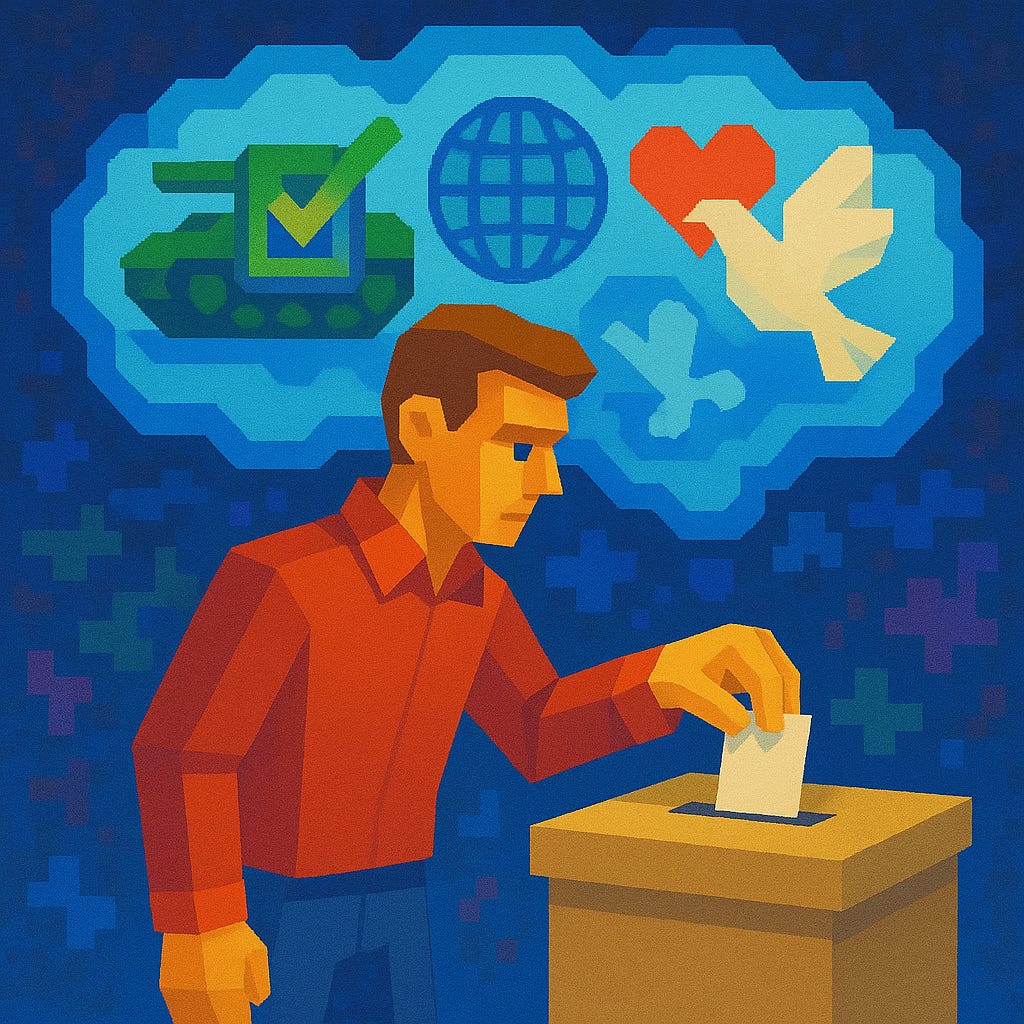
This is also why mass communication, like political speeches, often distills complex ideas into catchy slogans, making them accessible on a large scale at the cost of nuance.
Moving outwards from the center causes a signal dilution effect.
In contrast, the closer you are to the root circle, the more abstract and “wavy” the information is, and the harder it will be for you to materialize/capitalize on the range of feelings you have to get a single representation of it.
Romantic communication, for example, uses tools such as body language, touch, and smell to transmit a far bigger spectrum of information.
A soft touch communicates large volumes of feelings without a single word being spoken.
Lovers trade whole paragraphs in a raised eyebrow.

These non-verbal interactions operate on a deeper level, offering more complex and richer information.
You wouldn’t be able to pinpoint or label ideas inside the small-circles-non-verbal-interactions realm.
These deeply nuanced, high-resolution exchanges exist beyond labels.
If we lived forever, communication would look very different. Maybe we wouldn’t communicate at all. There’s something about the time pressure of mortal life (having an expiration date) that forces us to capitalize on our thoughts, even at the cost of sacrificing nuance and losing information.
Think of a politician: every move he makes must be rewarded within his term.
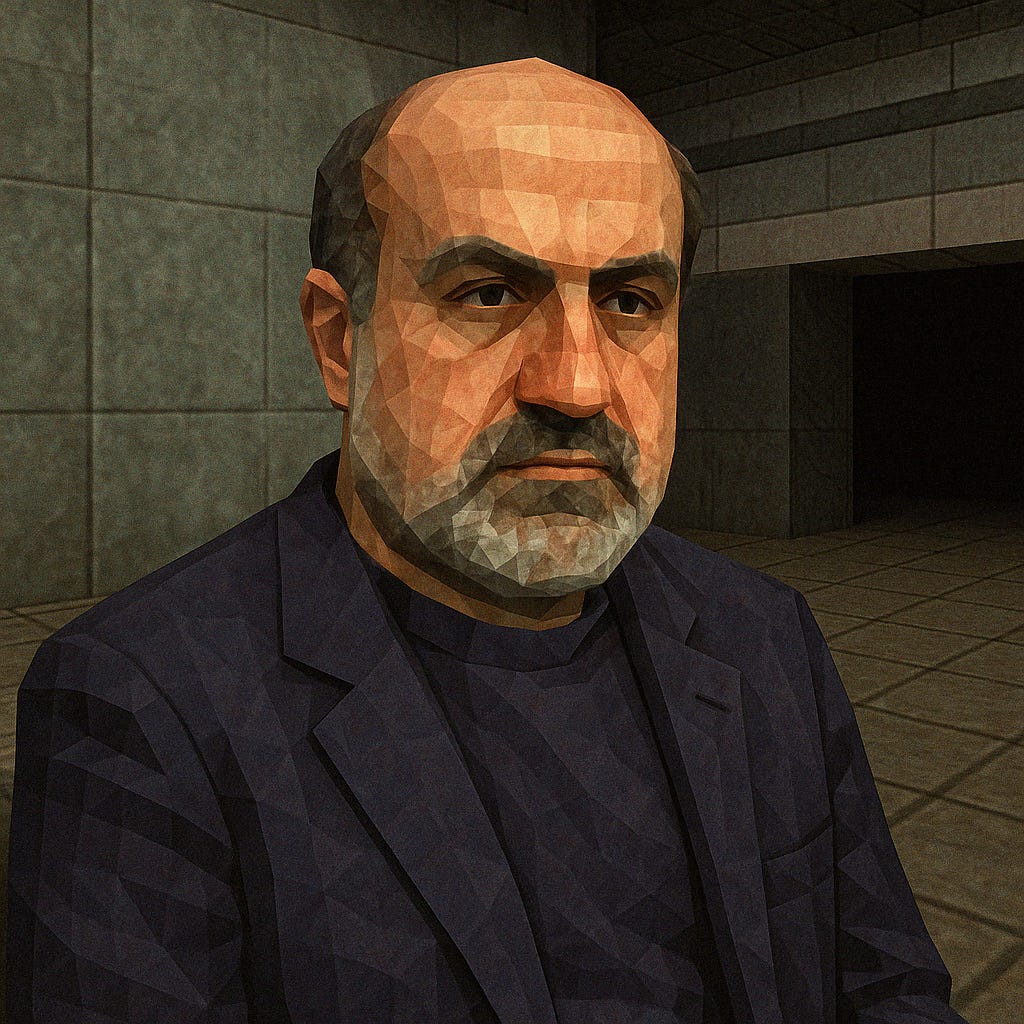
A quote from Nassim Nicholas Taleb that illustrates how the larger the scale you’re operating at, the more binary your decisions.
“With my family, I’m a communist. with my close friends, i’m a socialist. at state level politics, i’m a democrat. at higher levels, i’m a republican. at the federal level, I’m a libertarian”.
Communication Equilibrium
Equilibrium is the point where things even out. Nothing is pushing or pulling more than anything else. In a way, it’s an efficiency metric.
Imagine a chart where the x-axis is information you transmit, and the y-axis is information received by the other person.
When you communicate, it’s easy to assume that the more information you transmit, the more the other person will understand. At first, that’s true—understanding rises as you add context and detail.
But there’s a sweet spot where the idea fully “lands.” The recipient gets it.
Beyond that point, adding more information doesn’t just fail to help-it actually reduces understanding. Extra details blur the core message, introduce noise, and make the idea harder to hold in working memory.
So the curve doesn’t rise forever. It rises, peaks, and then drops once you cross the threshold where clarity starts turning into overload.
My ex
My ex used to say to me, “You are beating a dead horse“.
When is enough? How much information do you need to transmit to feel that it’s enough? Depends on your goals.
What are you trying to achieve? If you’re hungry and your goal is to make the other person come eat with you, saying “I’m hungry“ might be enough.
When you say “I love you“? What’s your goal? Why would you do that? What’s the information you are trying to communicate?
The closer a collective intelligence comes to this sweet spot, the smarter it is.

When we communicate and share ideas (different perspectives in space-time), we are constantly calculating how much energy to invest in each information transaction.
Organisms estimate the energy capacity they have to try find the sweet spot for communicating just enough information to achieve their objectives within their own and the receiver's energy constraints.
Communication Efficiency is:
Relevant information received / Total energy spent.
It’s like return on equity: how much outcome you create for the resources you use.
An intelligence can improve communication in several ways:
The sender can share more information, package it more efficiently (better compression).
The receiver can spend more energy processing the information, be more efficient in unpacking it, and improve their ability to extract meaning.
Bandwidth: Our different languages - text, body language, touch, etc, are all vessels for communication. Improving them increases our overall communication efficiency.
Chapter 3: Isolated communication
I’m not a physicist. I’m using quantum mechanics here as a poetic analogy.
Classical mechanics describes how the world operates at the resolution humans can experience. In contrast, quantum mechanics deals with the behavior of particles at extremely small scales, like atoms and subatomic particles.
In the realm of classical mechanics, systems are deterministic, and there is a direct relationship between action and reaction, allowing events to be predicted with high accuracy if initial conditions are known.
In contrast, quantum mechanics operates within the probabilistic realm, particles exist in multiple states simultaneously - a phenomenon known as superposition. This superposition persists until a particle is measured, at which point it collapses to a single state.
In quantum mechanics, (generally) a system’s behavior isn’t determined by its size but by how isolated it is from environmental interactions. However, when it interacts with its environment , a process called decoherence, these quantum properties fade and classical behavior emerges.
Connecting the dots
As mentioned earlier, “raw data” refers to all data in the world. “Perspectives” or “ideas” are what happens when we measure that raw data, and it collapses into a single representation in space and time.
For example, when I say “I’m poor,” I am measuring myself through society’s lens at this particular moment and place.
So, an individual’s perspective forms when one measures the wave of their own thoughts or feelings, collapsing possibilities into a specific position, moving from superposition to a fixed state, from wave to particle.
Our minds are like quantum systems, with every possible idea and perspective existing at once.
You could become a priest or a nazi, we all have the capacity to be both, but the probability of collapsing into one or the other differs for everyone.
Free will question - am I the one deciding when and where to collapse, or is it all just a predictable chain of events if we had enough data?
Our perspective is a way of measuring all the raw data we have from a single point in space-time.
Wave —» Binary —» Wave
When I communicate an idea, I “measure” my emotions, causing the wave of what I feel to collapse into a simplified, binary message.
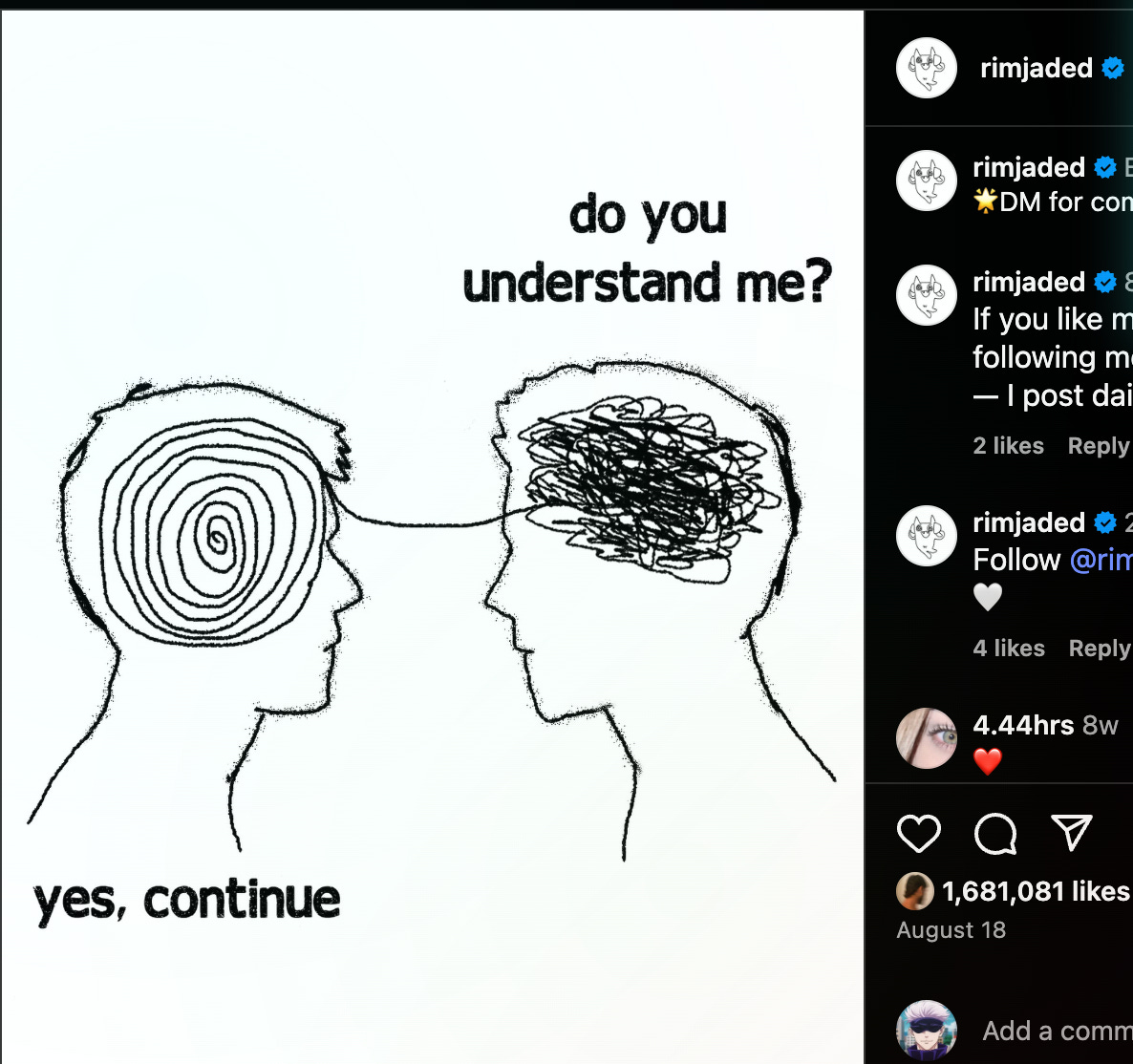
You, in return, take this binary message and try to reverse-engineer it, rebuilding the wave of emotion in your own mind.
But how close is my initial wave function to your reverse-engineered wave function? Put simply, how good do you really understand me? In this process, there are at least three narratives at play:
My Narrative: My original wave function - my actual, unfiltered experience.
Our Narrative: The binary representation we use to communicate - the expression.
Your Narrative: Your wave function - the version you reconstruct from my words from binary to wave.
For science enthusiasts: There’s a controversial and largely unproven theory called Orchestrated Objective Reduction(Orch-OR), which suggests that consciousness arises from quantum processes in the brain’s microtubules.
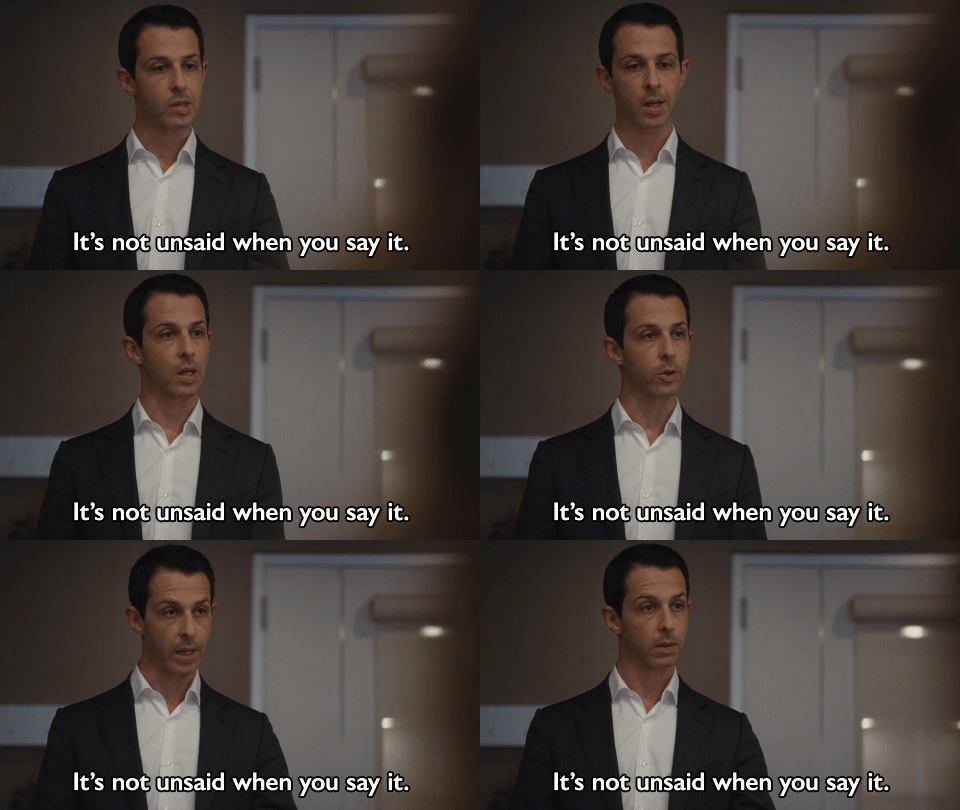
Chapter 4: Barbarians in love
Multiple interpretations of “reality” coexist. Each moment, seen from a particular angle, is a measurement.
As we move through life, our interactions with others cause our possibilities to collapse. Simply by being near each other, we begin the process of decoherence and start to lose our multidimensional qualities.
To reduce decoherence and maintain quantum-like behavior, we have to prevent ideas from interacting with other ideas — keep them isolated from fixed meaning.
In my life, I try not to force “understanding something“ which is the process of capitalizing on a feeling to turn it into a tangible thought.
Abstract art and music, for example, exist closer to this realm. In these “protected spaces,” ideas can remain complex and open-ended.
But the more we interact with broader social circles and more concrete ideas, the more our communication collapses into simpler, universally understood forms.
Inner circles = Low interaction, richer, more detailed states (superposition).
Outer circles = High interaction, more collapse into simple, common states (decoherence).
Interacting less with others allows you to appear less collapsed , more complex, less defined. Again, thoughts on Loneliness by Andrei Tarkovsky
Chapter 5: Examples?
Let’s see some examples of artists who implemented the idea of isolated communication that maintains a more “quantum” quality .
Crystal Pite — Video
“They take your gestures and postures, and they exaggerate them. They concentrate on them, isolate them, and elevate them so that what remains here on stage is something that is beyond words.”
Ohad Naharin — Video (Hebrew)
interviewer: “What is this movement that you said it contains both pain and pleasure? How can you feel it?”
Ohad: “First of all, a single idea is always bad, even if the idea is good”.
interviewer: “Why?”
Ohad: “Just think how bad it is when you have only a single idea… We always want to have multiple ideas at once. Only feeling pain is not good enough. We do that (have multiple ideas) to create something that has more than one dimension. If you connect to both pain and pleasure at the same time, it opens you this huge range in between to feel many many things.”
interviewer: “Can the movement contain these 2 feelings?”
Ohad: “Life contains these two feelings.”
Marty Neumeier — Video
“A brand is not a logo. A brand is a customer’s gut feeling about a product, service, or company. It ends up in their heads in their hearts. They take whatever raw materials you throw at them and they make something out of it. In a sense when you create a brand you’re not creating one brand (binary), you’re creating millions of brands like however many customers or people in your audience (superposition). Each one has a different brand of you. So it’s your reputation and everyone’s gonna feel a little different about what your reputation is.”
Thanks for reading!
Terms
Raw data: All the data in the world.
Perspective/Idea: A specific representation from a single point of view. It’s a product of a measurement in a specific space-time that collapses the superposition of the raw data wave function into a binary state.
Information-Resolution Elasticity
Reflects a trade-off between accuracy and ease of transmission. The simpler the communication, the easier it is to spread, but the less precise it becomes.Energetic Cost of Simplification
Each act of communication carries an energy cost, much like information loss in any physical transfer. We sacrifice detail for efficiency, knowing that some richness is inherently lost.Signal Dilution Effect - How the core message weakens as it spreads across larger audiences.